Search This Blog

Aishvaryam Youth Festival 2018


Maharaja Krishnakumarsinhji Bhavnagar University has celebrated the Aishwaryam youth festival of three days 26th, 27th, and 28th October. This whole festival of three days is hosted by Takshashila institute of commerce and Science college. The whole university was spangling with lights. This festival is for young people. This is not only for watching. This festival let young generation show their talents through various competitions. In which they include every type of talents like writing, singing, dancing, drawing, acting, playing instruments and many things. It includes modern and folk both the theme. I was present in some of the events which here I am trying to look critically towards it.

I have witnessed events like below...
  • poetry recitation, 
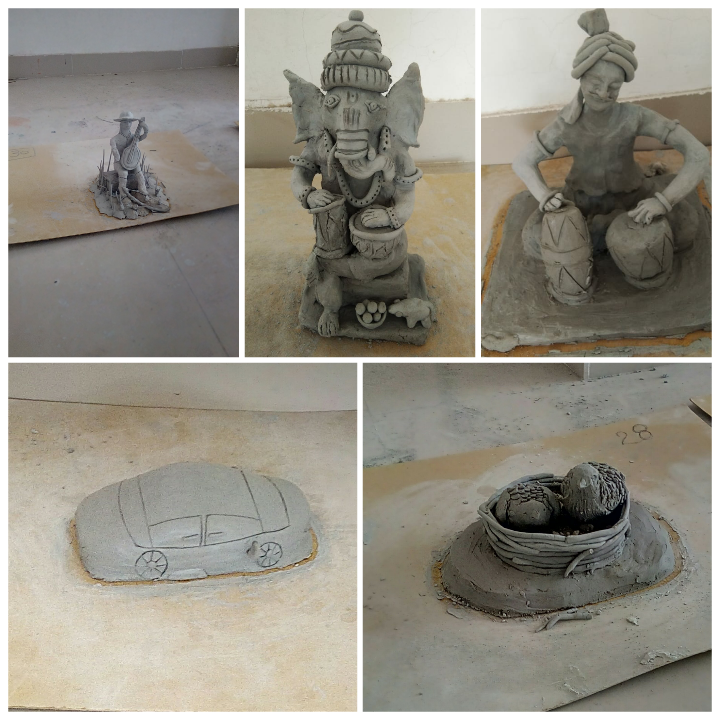
  • clay modeling, 
  • collage making, 
  • poster making,
  • painting, cartooning,
  • Rangoli
  • installation.


  • poetry recitation, 

We have the competition of self-written poetry and recitation. 20 to 25 students have participated in this competition. The subject on which poetry should be written is given on the spot. The subjects are like, the story of a pen, song of rain which does not come, feelings of jungle girl, the significance of friendship or love, life could may life will be an homage and on Diwali. Most of them have written on friendship or love and the story of a pen. On Diwali as per my knowledge, no one has written. With this topics, I have seen that most of them are using old metaphors like for pen they use sword and pen has seen the best of the best things and worst of the worst things. On friendship also almost all of them are praising their friends and some also has written on love. When everyone has recited their poem one of the judges who came to give their overall feelings has recited her one of a poem which was titled as “Shyam Mari Windows Par Kem Na Ave?” and she also has used new metaphors like hang, memory, ram and many more. These new metaphors are missing in the poems. 
  • clay modeling, collage making, poster making, painting, cartooning,
Again, on the final day of youth festival, I have attended Exhibition of these all arts. In Rangoli, all Rangoli were traditional but one from my department was mixing of traditional and Digital world. In on the spot painting, there were many paintings related to #Metoo movement and about the digital world. Students drew advantages and disadvantages of the digital world and some painting about traditional classroom and Smart classroom. Collage and Cartooning also very interesting related to a current issue in a satirical tone. I didn't find any modern arts like an art of Dadaism and Surrealism. At last, all arts were conveyed very good messages to society through these arts. The art was very good. Most of the participants have followed only the same themes like making an idol of God, nature or persons who are playing instruments. Some are very nice. In modern themes, one has made a car other than that we can not find any new or modern theme in it.

  • Rangoli

There were many Rangoli at the youth festival. Most of them are the typical traditional Rangoli. The one Rangoli which I like most is this Rangoli. In this Rangoli, we can see Nature and technology together. Nature and technology both are an important part of human life. In this Rangoli, both are equally important. Nowadays technology is the most significant part of human life. Facebook, Twitter, Google Plus, WhatsApp, Blogger, YouTube and Google maps make life easy and fast. Within that Nature also very important part of life. So in this two type of things brings together in one Rangoli. It also reflects tradition and modernity in art.


  • Installation : 

In this, all are very good work but one which has grabbed my attention is with hat and boots, which suddenly reminds me of the play “Waiting For Godot” by Samuel Beckett. Though it doesn’t have that theme as per my interpretation it wants to show the necessity of money that money is the key of every lock.


 Installation the idea itself the progressive way of giving a message by using useless things. In this, it gives the message of cleanliness, traditional musical instruments, religion and traditional festival celebration like Navratri..etc.


Interaction with Dr. Javed Khan Sir


In our Department of English, we have three days guest lecture from 16 August to 18 August by Prof J.H. Khan. Lectures taken by him was very fruitful and knowledgeable for all of us. Sir talked on NET /SET and ELT. He is an ELT specialist. He has a deep knowledge about ELT.


  • Interactions In class


In his very first interaction on ELT (English Language Teaching), he talks about to know the difference of teaching English as native language and English as a foreign language. Both should have different needs and different ways to learn and teach. Then he talked about ELT for primary education and English for higher education. How the level of students differ at every level and how we still have methods of primary education level in the syllabus to learn.

In that ELT class, he taught us about what is ELT, how ELT if different in school level and higher education. He discussed ESP, EAP and other things. He also introduced us about other important words like Microcardial, morphology, cockney dialect etc. He gave the knowledge about language, inflexious, semiotics etc how used in ELT. He also mentioned about characteristic of knowledge era, what is assessments etc. His English language is perfect and speaking fluently. He has very good communication skill and he has one capability that he can make the class live. He loved to communicate with youth. He taught us all the things with fun and we had not felt boring. He also made a presentation about all the topic. He gave the information of Net/set examination, what material we should read, how one can prepare for it etc. Javed sir gave the information about assessment and evaluation. All the points of ELT  discussed by him, connected with each other. He said that in order to gain the knowledge you should seek it.


  • Key concept on ELT discussed in the class:

As above mentioned that the English language is widely using in the world, in every interdisciplinary like Commerce, science, Arts, Medical, Engineering etc. About the concept, sir talked about ELT and its various manifestation in which sir explained various purposes for teaching English as follow:


  • TENI - Teaching English as native Language.
  • EFL - English as a Foreign language.
  • ESP - English for a specific purpose.
  • Linguistic.
  • Semiotics.
  • Grammar.
  • ESL -  English as a second language.
  • EAP - English for academic purpose.
  • Phonetics
  • Graphology
  • Morphology
  • Etymology

From these points, sir gave us the concept about the function of the English language in various field. especially, English for specific purpose and English for academic purpose in which sir talked about the language that language is a social institution, it is a product of culture. So, through the language, we can understand the cultural dimension.


  • Notes Taken by me during Khan sir's class.

  •  Learning experience :


      It was a unique experience to attend his lectures. From the first day, he gave one motto which we should keep in mind forever. That be a seeker, don't demand.  According to him, one should be active in the class. A good student always possesses good confidence. He stressed on the reading. In this way, we get the basic essential idea about ELT in these three days of learning. It helps a lot in understanding the concept in a clear-cut way. With ease, all points get covered by Prof. Javed Khan sir about ELT.


The Birthday Party by Harold Pinter


Post view task: The Birthday Party by Harold Pinter

Hello readers,
                      This blog is a part of the post-viewing task of the play "the Birthday Party" written by Harold Pinter in 1957 and directed by William Friedkin, a 1968 film in which our Professor Dr.Dilip Barad sir gave us a task to interpret the movie. Here is the blog link of the given task click here.


1]  Why are two scenes of Lulu omitted from the movie?
  • Lulu 's two scenes omitted from the movie because probably director doesn't want to show violence into his film. It may disturb readers. Also, the center of the film is Stanley, Goldberg and McCain. So male is the center of the film. If the director shows the scene in which Lulu harassed by Stanley. We felt more sympathy for Lulu, not Stanley. So maybe it is the reason for omitted the scenes.

2]  Is movie successful in giving us the effect of menace? Where you able to feel it while reading the text?

  • yes, the movie giving a successful effect of menace. While we are reading the play at some level it creates that kind of effect but not that much like film does because the audio and visual effects are more effective than reading a text. In the movie, we find the effect of menace clearly in the interrogation scene where the number of the question asked and through the loud sound effect and Stanley was sweating in fear and frustration and when Stanley hears about the two strangers he runs in a fear.


3]  Do you feel the effect of lurking danger while viewing the movie? Where you able to feel the same while reading the text?

  • Yes, throughout the movie we can find the effect of lurking danger when door knocking and in the interrogation scenes. Furthermore, we can find the lurking danger when Mccain tears newspaper in pieces. In the play, we can find when we think who drive the car where s/he going and interrogation scene of text.

4]  What do you read in 'newspaper' in the movie? Petey is reading the newspaper to Meg, it torn into pieces by McCain, pieces are hidden by Petey in the last scene.


  • Newspaper can be seen from both sides means positively and negatively.newspaper is a symbol here. newspaper gives us information about all the thing whatever happens in society. petey is reading a newspaper which means he faces the reality but he is reading to meg which means he is hiding from Meg.


5] Camera is positioned over the head of McCain when he is playing Blind Man's Buff and is positioned at the top with a view of a room like a cage (trap) when Stanley is playing it. What interpretations can you give to these positioning of camera? 


  • while seeing the film camera talks everything.thus when a camera is positioned over the head of McCann when he is playing blind buff which demonstrates that McCann is at a power position and is situated at the top with a perspective of the room like a trap which symbolizes that Stanley is trapped by a stranger who was touching him.


 6] "Pinter restored the theater to its basic elements: an enclosed space and unpredictable dialogue, where people are at the mercy of one another and pretense crumbles." (Pinter, Art, Truth & Politics: Excerpts from the 2005 Nobel Lecture). Does this happen in the movie?

  • Yes, these all things are reflected in the movie. We don't know some characters and why they are coming as like politics. We can also see that an artist is not free to do whatever they want. So, these things reflected in the movie.


7]  How does viewing movie help in better understanding of the play ‘The Birthday Party’ with its typical characteristics (like Pinteresque, pause, silence, menace, lurking danger)?


  • Obviously yes, this movie helped me a lot in developing the different insight of watching movies.  By reading, we may not get exact effects of it. We can feel the Pinteresque qualities in the movie like pause, silence, lurking danger like knocking and in the game of blindman's buff. Throughout the movie, the shrill voice gives more fearful effect. 


8] With which of the following observations you agree:

o   “It probably wasn't possible to make a satisfactory film of "The Birthday Party."
o    “It's impossible to imagine a better film of Pinter's play than this sensitive, disturbing version directed by William Friedkin”. (Ebert)


  • According to me, both are right at its own place. Because everything has its own limitation that it can’t go beyond the limitation. Same thing if we apply here in the movie or in the text of the play then we realized that both has its own charm to satisfy the needs of the readers or the viewers. 
9]   If you were a director or screenplay writer, what sort of difference would you make in the making of the movie?   Who would be your choice of actors to play the role of characters?


  • According to me, the movie is very much accurate to the original play there is no need to change or add the things in the movie because the setting, character, camera work, dialogue everything is perfect.  

Thinking Activity on Existantialism

Hello, readers
                       This blog is a part of Flipped Learning activity in which the task is to watch videos about Existentialism and write down whatever you understand. Here, is the link of the teacher's blog; click here.


What is Existentialism?

Existentialism. A difficult term to define and an odd movement. Odd because most thinkers whom the intellectual world categorizes as existentialists are people who deny they are that. And, two of the people whom nearly everyone points to as important to the movement, Soren Kierkegaard and Fredrich Nietzsche, are both too early in time to be in the group, thus are usually called "precursors," but studied and treated as members of the group. Major figures like Jean-Paul Sartre, Martin Heidegger, and Albert Camus all flatly deny they are in the movement, yet everyone says they are central.

Secondly, the term is very difficult, if not totally impossible to define. What is existentialism? I've been asked that a thousand times, have read most intro type books on the field, have spent much of my teaching life "doing" Existentialism, yet cannot give a coherent and relatively short definition. It's sort of a spirit or aura of how one responds to human existence, much easier to characterize in negative terms -- what Existentialism is NOT that philosophy generally is -- than in positive terms of a definition. (Webster)


#Video-1
The great thinker and writers such as- Kierkegaard, Nietzsche, Dostoyevsky, Kafka, Heideggar and many more different in their views but for all of them, philosophical thinking and existentialism begin with the subject namely the individual. It could be seen as a triangle with- Individuality, freedom, and passion as its three sides. Believing or not believing in God can only be possible when one thinks as an individual. They Focus on ideas that belief in God is Philosophical suicide. existentialist emphasis the subject of emotion, anguish, and despair.

#Video-2
 Life if full of absurdity. The uselessness of suffering and repetition of same is an absurd reasoning. Another thing is that there is a truly serious problem and that is Philosophical suicide. "An elegant suicide is an ultimate work of art." Albert Camus does not only believed suicide an art, but he said it an ultimate art. when we think about absurdity of life, you feel like a darker side of life.

#Video-3
In this video, Camus says that seeking what is true is not seeking what is desirable. The idea is the same as truth is always bitter. Seeking truth is not desirable. Instead, truth leads toward despair. And in the opposite of we seek desirable things, it does not lead towards truth.

#Video-4
Dadaism is connected with the nihilism. Dadism is the quest for change, is against any existance value and rules ns it association with nihilism. Creation is the primary goal of Dadaism and its merely an art movement. Dadaism is the socratics of the warriors. Offering dadaism as the way of becoming free of everything. It said that “I don't want the value that other people invited”.

#Video-5
Is existentialism a gloomy philosophy? 
Existentialism is a gloomy philosophy because it became famous after world war 2. Every life is full of adversity, anxiety, despair, absurdity. But we are free to choose our own way of living. once we chose the things then we are responsible for its consequences.

#Video-7
Existentialism counters the nothingness of existence by embracing existence itself.

#Video-8
 Friedrich Nietzsche gave the theory of "Ubermensch" it means man as a superman. He believed that "God is dead". When human beings start in believing that there is no God then they become free of doing anything they want or  desire; without harming others. Existentialism is not believed in those rules which imposed in us by various institutions but do whatever you want and make your own rules.

#Video-9
  Existentialism accepts human being as they are. existentialism allow living life in their own way. No rules catch you, but you can mack your own rules. As per Nietzsche's idea of ubermensch, his superman can do anything but the only thing should remember is do whatever you like but without harming others and do by your own ideology.

#Video-10
Essentialism means whatever they think on earth expect human all that thing have their own essence. Absurdity is the search for an answer in an answerless world. 


2] Video no.8 I like the most because it gives the idea of "Ubermensch". It means man can do anything he wants. also This video help to understand existentialism very simple and easy way.  


3] Flip learning is always beneficial for the learners because as we all know our mind can capture more data by visuals rather than only by listening and this platform gives us better understanding by the form of videos. Thank you all the resource persons for their great hard work thank you Barad sir for this activity.


Oneness of literature.

Online Discussion: Oneness of Literature


This Blog is a part of classroom activities in which students have to interpret two works one is T.S.Eliot's 'Wasteland' and another is the story ' The Joke' by Anton Chekhov.


All literatures are connected with each other; all, those which are already written, those yet to be written. Thus, to understand a work of art, one must have an understanding of this continuity. This means that a writer makes use of one sign, symbol, character, situation is used by other writers, and if this goes on recurrently happen it turns into literary metaphor.

“Every organized body of knowledge can be learned progressively; and experience shows that there is also something progressive about the learning of literature.”   - Northrop Frye

Theory of Archetypal criticism based on the idea that whole literature has oneness of it’s existence. All literature shares common DNA or Skeleton.

These lines from The Waste Land can better be understood if we read it in the context of short story of AntonChekhov (A Joke).

And when we were children, staying at the archduke's, 
My cousin's, he took me out on a sled, 
And I was frightened. He said, Marie, 
Marie, hold on tight. And down we went. 
In the mountains, there you feel free.

Interpretation of lines:--
An ordinary reader can't understand hidden meanings of these lines beacause of esoteric chracteristics of poem. It seems easy to read but when it comes to dipper meanings it can be understood by some extra ordinary people who has historical knowled of it. 
In the story as well as in the lines of Wasteland there is deep meaning inside it. The act of coasting is not just for fun or for other things. It indicates the first lustful act, first attraction. How the first relation made deep effect in one's life.
E.g.-
"That memory is for her the happiest, the most touching, the most beautiful one of her life. But for me, now that I have grown older, I can no longer understand why I said those words and why I jested with Nadia" 

Here we can interpret that  from " A Joke " by  Chekhov . Same theme as in " The Wasteland "  there all part reflects this theme and a  lustful relation of people in burning land . at some point both reflects same theme of ," Sexual Perversion " so it can be said that all literature connected with each other in terms of representing time, love , sexual Perversion, Good and evil , existence of God , nature of human beings this all things presented in one or another way.

On 'Orientalism': Edward Said

Here is my response to Identify 5 concept related Orientalism from the interview of Edwards Said.


5 concepts:-

1]What is Orientalism:
                                 As per the Said's words. Orientalism is not an imagination it is a material thing and genuine theory. Orientalism has revolutionized the study of MiddleEast and also useful to studies post-colonialism and other disciplines like History, Anthropology, Political science, and Cultural studies.

2] The idea of Difference:


The differences between different kinds of Orientalism are in effect the differences between different experiences of what is called the Orient. I mean the difference between Britain and France on the one hand and the United States on the other, is that Britain and France had colonies in the Orient. I mean they had a longstanding relationship and imperial role in a place like India so that there's a kind of an archive of actual experiences of being in India, of ruling in a country for several hundred years. And the same with the French in North Africa, let's say Algeria or Indochina, direct colonial experience. In the case of the Americans, the experience is much less direct. There's never been an American occupation of the Near East. So I would say the difference between British and French Orientalism on the one hand and the American experience of the Orient on the other is that the American one is much more indirect, much more based on abstractions. The second big thing, I think that differs in the American experience from the British and French of Orientalism, is that the American. Orientalism is very politicized by the presence of Israel for which America is the main.
3]Palestine Issue: 
Said talked about the issue of Palestine that what is the condition of the people there, they have not their motherland because of the forceful occupation by Israel. From 1948 to the present time Palestinian are suffering a lot for the peace and their homeland but Western countries do not take any kind of action on this issue. We also can say that why Europe and America built a new state for Jew people surrounding Islamic countries if they have a love for Jew people then why they vanished jew from Europe. So, Said explained this issue through cultural, religious and political views.

4]Idea of history


Every nation has its own history, the way we interpreted the history is quite different. History is not only about to understand our one's self but to understand our self in terms or in relation with the nation. Eg- Palestinian's local complexities, the mixed background of Arab Muslims, Arab and Jews, Arab Christian, Israeli Jews.

5]The authoritarian, hierarchical Model

I say, not all of us say, well they should be thrown out. Because we have been thrown out and so we have another vision, which is a vision of co-existence, in which Jew and Arab, Muslim, Christian, and Jew can live together in some polity, which I think it requires a kind of creativity, and invention that is possible – vision that would replace the authoritarian, hierarchical model. But this idea that somehow we should protect ourselves against the infiltrations, the infections of the Other, is, I think, the most dangerous idea at the end of the twentieth century. Unless we find ways to do it, and there are no shortcuts to it, unless we find ways to do this, you know there is going to be wholesale violence of a sort represented by the Gulf War, by the killings in Bosnia, the Rwandan massacres and so on. I mean those are the pattern of emerging conflict that is extremely dangerous and needs to be counteracted and I think therefore it's correct to say that the challenge now is – I wouldn't call it anything other than coexistence. How does one co-exist with people whose religions are different, whose
traditions and languages are different but who form part of the same community or polity in the national sense? How do we accept difference without violence and hostility?


THANK YOU

Interview of Shashi Tharoor


#In the interview of Shashi Tharoor I like these 3 ideas.

#GDP:
"The British came to one of the richest  countries in the world, accounting for 27% of global GDP in the 1700s and 23% in 1800s."
"Over 200 years of exploitation, depredation, loot, and destruction reduced it to a poster child for third-world poverty and just 3% of global GDP."

#Development of Railways:
 Nowadays Railways become most important part of India and all credit goes to Britishers but they never think about the benefits for Indian; they developed railways for their own selfish motives. britishers used to supply raw material to their own countries and therefore they constructed railways in only a few parts of India where they can get raw material easily.

#Exploitation : 
British always exploited Indian in every way. They taking goods from India. They took everything from India rather than spending money into the development of India. They always see their benefits first.  Mughals only spend Indian money into the development of India rather than taking it outside of India. Britisher had increased Export text and decrease import texts. So this way they taking raw materials from India and Indians have to pay high text and after that this raw material convert into things and import that material in India by paid lower text. So this way increased the text they exploit Indian. 

Guest lecture on Poe's short stories by Jay Mehta sir.

#GUEST LECTURE BY DR. JAY MEHTA.


We have often guest lectures in our English Department MKBU. Head of Department Dr. Dilip Barad invites various Professors from other universities. In the Same manner, From 18th to 22september, we had the lecture by Dr. Jay Mehta who has great skill to teach Edger Allen Poe’s short stories. Dr. Jay Mehta is one of former student and gem of our English Department MKBU. He is Lecturer at R.C.Technical College Ahmedabad. In the very beginning of this 4day session, he told us that- I will not let you feel bored in the class; and to prove this he used various techniques of teaching he taught us Poe's short stories with poems and Ghazals. He has good knowledge about Poe and his stories because he has completed his Ph.D. in this subject. Before the session, he gave us a very interesting task based on our real life and related to Poe's characteristic of Poe's story like you ever got angry or feel murderer? Do you believe in Ghost or not so on. To read pre-thinking task click here.

#He taught us 6 stories of Poe.

#Characteristics of his stories.

  • Insanity versus rationality
  • Obsession
  • Man's relationship with death
  • Love and hate
  • Curiosity
  • The double self

1) The Tell-Tale Heart


 #Theme
  • ØVersions of Reality
  • ØCunning and Cleverness
  • ØThe Home
  • ØMortality
  • ØTime 
2) The Black Cat

3) The Fall of the House of Usher

#Theme
  •  ØMorality
  •   ØMadness
  •   ØFear
  •   ØIncest
  •   ØFriendship
  •   ØBurial
  •   ØThe Art
4) The Cask of Amontillado

#Theme
  • ØFreedom and Confinement
  • ØBetrayal
  • ØDrugs and Alcohol
  • ØMortality
  • ØFoolishness and Folly 
5) The Purloined Letter
#Theme
  • ØCunning and Cleverness
  • ØLies and Deceit
  • ØVersions of Reality
  • ØPower
  • ØRules and Order 
6) The Gold Bug


Jay sir has started teaching us horror stories of Poe.  he said that -“Poe has believed that not a single word should be wasted.” Sir has made us realize by reading original stories that every word has something to convey and every word is connected. In horror stories of Poe, he shows us the human beings who have over acuteness of senses, who are cold-blooded murderers. They don’t have guilt on their acts. They called their act of murder a task, an assignment, a project, which are used in the positive sense but they are using it differently or they are trying to make us think positively on their act. Most of the stories have the first-person narrator but some also have the third-person narrator. With the use of psychology and Freud, sir make it easy to understand. “The Tell-Tale Heart”, “The Black Cat”, “The Fall of the House of Usher”, and “The Cask of Amontillado” these are the horror story and “The Purloined Letter” and “The Gold Bug” are the detective and treasure hunt stories.


My learning experience: Without any doubt, I can say that Jay sir is a great teacher. The teaching style was very interesting because we couldn't feel boredom because sir had various examples to teach this story. I liked the teaching method of Jay sir because he was explaining the story with psychoanalytical perspective and reality-based examples.He increased our vocabulary of Gothic. The surprising thing was that a soft-hearted person is teaching us stories of horror, terror, murder etc. 
“A poem a day keeps psychiatrist away”- these are the words of Jay sir and at last day he ended with poetry session. 

Post-colonial studies: Movie screening- 1] Midnight's children and 2] The Reluctant Fundamentalist

On 9 September 2018, we had a movie screening of "Midnight's children" and "The Reluctant Fundamentalist" at the Department of English, MKBU. So, this blog is a review of two movies from the post-colonial perspective, as a part of academic activity.

Here is the blog link of given task: Click here


#Post-Colonial studies

#Movie-screening

#Midnight's children

#1947- Independence of India


Midnight's Children is the movie directed by Deepa Mehta, which is an adaptation of Salman Rushdie's 1981 novel. Fact is that it's also not considered as a good adaptation because it is merely impossible to convert the words Rushdie into the picture. Movie and book both deals with India's transition from colonialism to Independence as well as it deals with some high remarkable topics like the Partition of India and Pakistan, Magic realism, emergency etc.


This book got Booker Prize and James Tait Black Memorial Prize in 1981, it was also awarded the Booker of Bookers prize and also considered as the best all-time prize winner. Here we can often find some Chutnification of language as well as chutney appears many times in a symbolic way, as a symbol of mixing of so many things. 


Mr. Rushdie takes time of two years to pare down 600-pgs. book into a 130-pg script. His use of language makes him differ from other Indian English writers; his use of numerous Urdu and Hindi words without translation reflects his overconfidence. He represented the allegorical image of India. History and nation both narrated in a fictional way. Whatever happened in the novel has actually happened in India, but the use of metanarrative technique itself created doubt in the narration.


#Postcolonial views:

  • Hybridity     
               #E.G.- Rushdie himself Saleem is a perfect representation of hybrid male born with multiple allegiances and identities.
  • Emergency 1975
        #Real nature of Indira Gandhi and her policy towards poor and rich as well as her decision of putting emergency for her personal benefits.
  • Vasectomy
        #Congress policy for poor people, they believe that poor can't have family and thus they did vasectomy of poor. 
  • postcolonial feminism
        #E.G.-In the beginning of the movie Doctor did not allow to examine Naseem's illness to see her body, there a curtain between doctor and Naseem.
  • Magic Realism
        #E.G.-  Magic realism is really presented well here in this movie. Here,  Parvati saves first Saleem's life and then her child's life by magic. In this movie, all characters are portrayed well specially Saleem,  Shiva, and Parvati. 


#The Reluctant Fundamentalist

#9/11- Ground Zero


During the discussion of the postcolonial study, we have watched the film 'The Reluctant Fundamentalist' which was directed by Meera Nair. The film narrates the life of one Pakistani who is capable to work among American people but just being a Pakistani he suffered a lot and consider as a citizen of the second world. His self-respect has vanished with his clothes. He becomes a victim of the situation and it's made a great impact on him. An educated person is considered as a terrorist who is actually a teacher but he needs more security for him because other want to kill him and this security made his frame as a terrorist. This movie is directed by Mira Nair and it is based on the novel with the same title written by Mohsin Hamid. The main theme of the movie is how Muslim's were disrespected after the attack of 9/11. Here the protagonist Changez Khan goes to America to earn money. He makes friends fall in love with the American lady. But after the attack of 9/11,  his colleagues started misbehaving with him. We can see a postcolonial aspect here when the Muslims are disrespected by the Americans. 


Thank you


BRIEF NOTES ON APPROACHES ELT.

TO EVALUATE MY ASSIGNMENT CLICK HERE. 


BRIEF NOTES ON APPROACHES ELT.

Ø Prepared by     : KAVITABA P. GOHIL
Ø Roll No: 19
Ø Batch                   :  2017-19
Ø Email                   : kavitabaprahaladsinhjigohil@gmail.com
Ø Enrollment No: 2069108420180018
Ø M.A (English)   :  SEM -3
Ø Paper – 12   : ELT-1
Ø Submitted to:  Smt.S.B.Gardi, Department of English,                                                                                               MK Bhavnagar University.
Ø Words count: -


#INTRODUCTION:

Today, English is the world’s most widely studied foreign language. Five hundred years ago, Latin was the most dominant language to be studied because it was the language of business, commerce, and education in the western world. In the sixteenth century, however, the French, Italian and English gain in importance because of political change in Europe and Latin gradually became displaced as a language of spoken and written communication
In the eighteenth century, when modern languages began to enter in the curriculum of the European countries, these languages were taught by the same methods as the Latin language was taught. Grammatical rules were memorized. Written practices were done. The passages were translated from the second language to the first language and vice versa (ibid).
By the nineteenth century, this method was considered as a standard method of teaching language. The textbooks were divided into chapters. Each chapter contained a certain grammatical rule and rule was practices with many written exercises.

#VARIOUS APPROACHES:

#Structural Approach:
The Structural Approach is based on the assumption that language can best be learned through a scientific selection and grading of structures or patterns of sentences and vocabulary. The stress is on the learning of essential structures of English.
In the words of Menon and Patel: "The Structural Approach is based on the belief that in the learning of a foreign language, mastery of structures is more important than the acquisition of vocabulary." This approach employs techniques of the Direct Method of teaching but the use of translation is not wholly discarded. Teaching is done in situations. Speech is mainly stressed but reading and writing are not neglected. Structural Approach is essentially what the term implies-an approach and not a method as such. There is scope for limitless experimentation in imaginative ways of applying the Structural Approach in the classroom. Prof. C.S. Bhandari has rightly remarked: "It is not proper and correct to call the Structural Approach a method of teaching. It is not a method; it is an approach. Any method can be used with it"
The Objectives of the Structural Approach According to Menon and Patel the following are the objectives of the new Structural Approach:

1. To lay the foundation of English by establishing through drill and repetition about 275 graded structures.
2. To enable the children to attain mastery over an essential vocabulary of about 3,000 root words for active use.
3. To correlate the teaching of grammar and composition with the reading lessons.
4. To teach the four fundamental skills, namely, understanding, speaking, reading and writing in the order named.
5. To lay proper emphasis on the aural-oral approach, active methods and the condemnation of formal grammar for its own sake.
Principles of the structural approach

=The principles of the Structural Approach may be as under:
1. Forming language habits.
The Structural Approach gives due importance to the forming of language habits. The learners should acquire the habit of arranging words in English standard sentence patterns through language drills.
2. Importance of speech.
The Structural Approach regards speech as more important than reading and writing. Speech is the necessary means of fixing firmly all groundwork.
3. Importance of pupil's activity.
The Structural Approach puts more emphasis on pupil's activity than on the teacher's. The child is the learner, so he must be actively involved in the teaching-learning process. From the above three principles, we observe that speech and oral work are the core of the structural way. The pupil himself assumes prominence in every activity connected in the new way of teaching and learning the language. Oral work, in fact, is the sheet anchor of the approach. The whole approach is based on the principle "that language is learned through use, and that the use of it is almost always accompanied by an activity of some kind. Pleasurable activity is the secret of success in language assimilation."

# Oral Approach/ Situational Language Teaching:
The oral approach is a method in which children to use whatever hearing they get from their surroundings. They also take help from the context to understand and use language. The target is to develop the skills in the individual so that he can communicate and function independently. This approach helps in the development of reading and writing skills (Richards and Rodgers, 2001).
The oral approach was developed from the 1930s to the 1960s by British applied linguistics such as Harold Palmer and A.S. Hornsby. The main difference between oral approach and the direct method was that the methods, which were developed under this approach, had theoretical principles about the selection, grading, and presentation of the content and material. This sequencing of the content would lead to better learning with a good knowledge of vocabulary and grammatical patterns. In this approach all, the points of language were to be presented in “situations” which led to the second name of the approach i.e. situational language teaching. Although, the teachers are not aware of this approach today but, it had a long-lasting impact on language learning. However, its focus on oral practice, grammar, and sentence patterns are still supported by the teachers.

#Natural Approach:
In 1977, Tracey Terrell proposed the natural approach to language teaching. This approach was influenced by Stephen Krashen’s theory of language acquisition. The natural approach focuses on communication as the major function of language. In this approach, language is considered as the vehicle or means of conveying a message and information. The natural approach was actually based on the observation and understanding of the acquisition of the first and the second language in informal settings (Richards and Rodgers, 2001).

# Communicative approach:
Communicative language teaching (CLT), or the communicative approach, is an approach to language teaching that emphasizes interaction as both the means and the ultimate goal of the study.
Language learners in environments utilizing CLT techniques, learn and practice the target language through the interaction with one another and the instructor, the study of "authentic texts" (those written in the target language for purposes other than language learning), and through the use of the language both in class and outside of class.
Learners converse about personal experiences with partners, and instructors teach topics outside of the realm of traditional grammar, in order to promote language skills in all types of situations. This method also claims to encourage learners to incorporate their personal experiences into their language-learning environment, and to focus on the learning experience in addition to the learning of the target language.

According to CLT, the goal of language education is the ability to communicate in the target language. This is in contrast to previous views in which grammatical competence was commonly given top priority.CLT also focuses on the teacher being a facilitator, rather than an instructor. Furthermore, the approach is a non-methodical system that does not use a textbook series to teach English but rather works on developing sound oral/verbal skills prior to reading and writing.


#REFRENCES:

MY POSTS

Assignment -5 TECHNOLOGICAL ADVANCEMENT AND HUMAN LIFE.

  "TECHNOLOGY" - this word is derived from the Greek word "technology",--techno--> an art, skill or craft and --loggi...